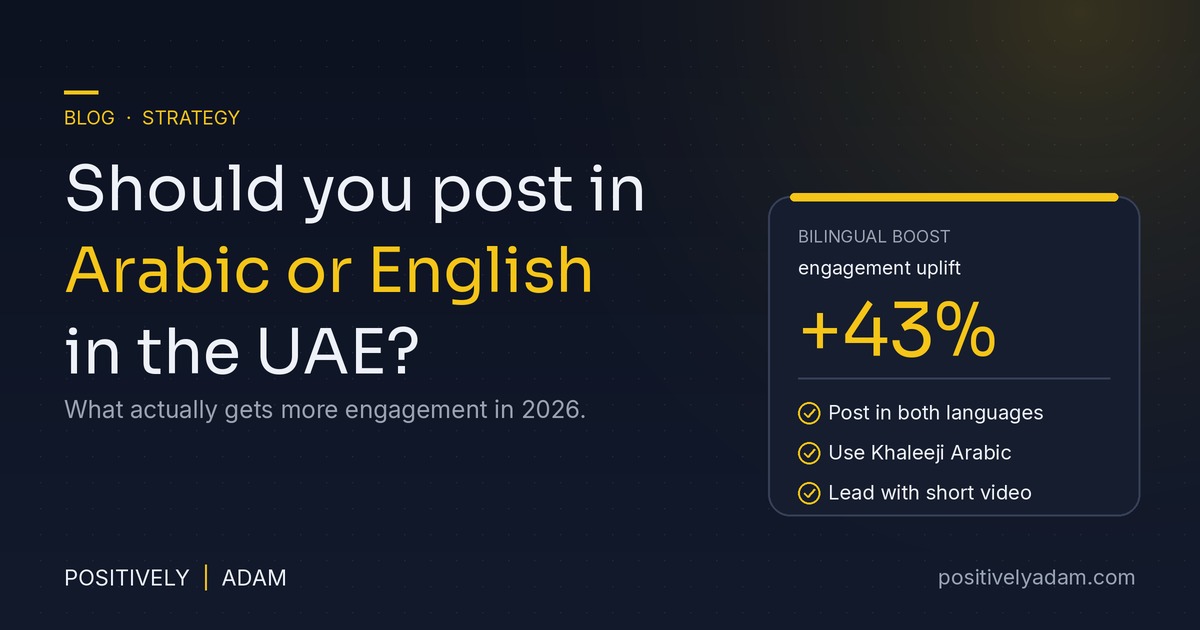
For most businesses in the UAE the honest answer is both, but not in equal measure. Posting in both Arabic and English consistently beats English-only, with bilingual content earning up to around 40 to 43% higher engagement from local audiences. The real skill is knowing which language should lead on which platform, and for which post.
Why English-only quietly caps your reach
The UAE is one of the most connected markets on earth. There are more than 11 million active social media users here in 2026, close to 99% of the population, sitting across a country of roughly 11.5 million people. Around 1.33 million of those are Emirati citizens and the rest are expats, and most Emiratis are fully bilingual. English feels like the default because so much business runs on it, but defaulting to English-only is exactly where the reach leaks. Brands that post only in English miss roughly 25 to 30% of the incremental engagement they could be earning through bilingual posting.
What the 2026 numbers actually say
The data on this is consistent and it points one way. Bilingual Arabic and English campaigns deliver around 40 to 43% higher engagement than English-only posts, and professionally produced Arabic content can pull 40 to 55% higher engagement from Emirati and Arab expat audiences. Content that leans into local identity performs even harder: posts featuring UAE landmarks, Arabic language elements and regional cultural references see about 45% higher engagement from local audiences. During national and cultural occasions such as National Day or Ramadan, bilingual content adds up to another 28% on top.
Put simply, Arabic is not a nice-to-have box to tick. In 2026 the demand for original Arabic content has hit a tipping point and Arabic short-form video is badly underserved, which means there is genuine reach available to any business willing to make it.
When Arabic should lead
Let Arabic take the lead whenever the post is aimed primarily at Emiratis or Arabic-speaking expats, when it ties into a national or religious moment, or when the tone is personal, warm and community-led. One thing worth getting right: use Khaleeji (Gulf) Arabic, not Egyptian or Levantine. UAE audiences respond noticeably better to the Gulf dialect, and generic Modern Standard Arabic can read as stiff or corporate in a caption. If you are running short-form video, an Arabic hook in the first three seconds is doing a lot of quiet work.
When English is the right call
English still earns its place. It leads for B2B content on LinkedIn, for the international expat and tourist audience, and for technical or professional services where the buyer thinks in English. The mistake is not using English, it is using only English and assuming that covers everyone. A good rule of thumb: English carries the message to the widest professional audience, Arabic builds trust and belonging with the local one.
How to run a bilingual feed without doubling your workload
You do not need to translate everything twice. The efficient way to do this is to lead each post in one language and add the other as a supporting layer, a shorter caption, a key line, or on-screen text in video. Design matters here too: Arabic is right-to-left, so captions, graphics and reel text need to be laid out properly rather than pasted in as an afterthought, which is where having proper graphic design behind your content really shows. Short-form video is your best friend either way, because Reels and TikToks generate about 2.5 times more engagement than static posts, and a bilingual on-screen hook travels further than a wall of translated text.
This is exactly the kind of thing that eats a business owner's week if you try to do it yourself, and it is the sort of work I handle end to end. If you want a feed that speaks to both sides of the UAE audience without you touching it, take a look at our packages or book a free strategy call.
Key takeaways
- The answer is both languages, not one: bilingual content earns up to around 40 to 43% higher engagement than English-only.
- English-only leaves roughly 25 to 30% of available engagement on the table.
- Use Khaleeji (Gulf) Arabic, not Egyptian or Levantine, for UAE audiences.
- Let Arabic lead for local, cultural and community posts; let English lead for B2B, expat and international reach.
- Lead in one language and layer the other, and put it in short-form video where engagement is about 2.5x static.
Frequently asked questions
Should I post in Arabic or English in the UAE?
Post in both. Bilingual Arabic and English content earns up to around 40 to 43% higher engagement from UAE audiences than English-only, so the goal is a mix rather than choosing one language.
Which Arabic dialect works best for UAE social media?
Khaleeji (Gulf) Arabic. UAE audiences respond better to Gulf dialect than to Egyptian or Levantine Arabic, especially for casual captions and short-form video.
Do I need to translate every post into both languages?
No. A smart approach leads in one language per post and adds a shorter version or key line in the other, rather than posting identical full translations of everything.
Does Arabic content really get more engagement than English?
Yes, with the right audience. For content aimed at Emiratis and Arabic-speaking expats, Arabic and bilingual posts consistently outperform English-only, and posts using local cultural references see around 45% higher engagement.
Want this handled for you?
I run social media end to end for businesses across the UAE. Strategy, design, posting and reporting in one monthly package, in both Arabic and English.
Book a free strategy call →